2020.02.07 Economic outcomes: Unifying and Segmenting Markets
The organization of the conference on "Populations Transfers on the European Continent during the First Half of the 20th Century: Socio-economic Outcomes and Perceptions of Displacements" focused on the forced population movements that took place on the European continent after the end of the First World War, but expanded its chronological and spatial horizon to the “waves of refugees” caused by and in the aftermath of the Second World War.
The objective of the Conference "Population Transfers on the European Continent during the First Half of the 20th Century: Socio-economic Outcomes and Perceptions of Displacements" is threefold.
First, it aims at enlarging the historiographical interpretation of refugee movements in the 20th century. Second, it intends to open comparative perspectives on these movements. Third, it aims to remove them from the national context in which they have mainly been studied so far. The conference focused both on the technical and economic conditions underlying the forced population movements and on the consequences of these demographic changes on the economic and social levels.
These questions include the know-how that has been generated by the population movements, in conjunction with social networks. With regard to the Greek case and other population movements following the First World War, the workshop particularly aimed at deepening the understanding of the role of the League of Nations regarding the movement and settlement of these populations, as the international organization has become an important actor in the inter-war period by producing know-how and establishing networks of experts.
In addition, the workshop aimed at exploring the perception of displacement by the populations themselves, at the intersection of the individual experience of dystopia and the technical and economic conditions of official sources (whether international or national). An overall methodological challenge for the Research Project is the use of interdisciplinary tools; these comprehensive tools are required in order to achieve the afore mentioned objectives
The Seminar Economic outcomes: Unifying and Segmenting Markets was integrated to the Conference Populations Transfers on the European Continent during the First Half of the 20th Century: Socio-economic Outcomes and Perceptions of Displacements. In this specific part of the Conference were presented papers investigating the social and economic aspects of the refugee establishment in Greece during the Interwar period. Papers on these topics were presented by Margarita Dritsas, Lefteris Tsoulfidis and Antonis Antoniou.
Margarita Dritsa
Refuge, Repatriation and Migration in Greece: 1900-1960
Among European States, Greece has had a long experience of migration both inward and outward starting with its emergence as a new European State in the 19th c. and continuing all along the 20th.
The massive displacement of Greek-speaking and Greek Orthodox populations from the Ottoman Empire/cum Turkish Republic between 1910 and 1930 is probably the best known and documented case in contemporary Greek history. That part occurring within the framework of the formal Treaty for the Exchange of Populations between the two countries was only one side of the phenomenon. Besides, they were not the only forms of migration nor were they restricted to the first quarter of the 20th. In addition to them, there have also been semi-voluntary migrations to other counties where Greek communities had already been established earlier, as were semi-forced or preventive migrations throughout the 20th c.
In addition to the case of Greek refugees from Asia Minor, the case of a different group, the ‘Aegyptiotes’ Greeks settled in Egypt since the 19th c. and massively migrating back to Greece in the 1950s will be also examined. Perceptions of these different groups across time, the framework ( national/international) within which such migrations occurred, the impact of several interacting factors, including specific state policies - or the lack of them - on the socio-economic environment and settlement will be examined and appraised.
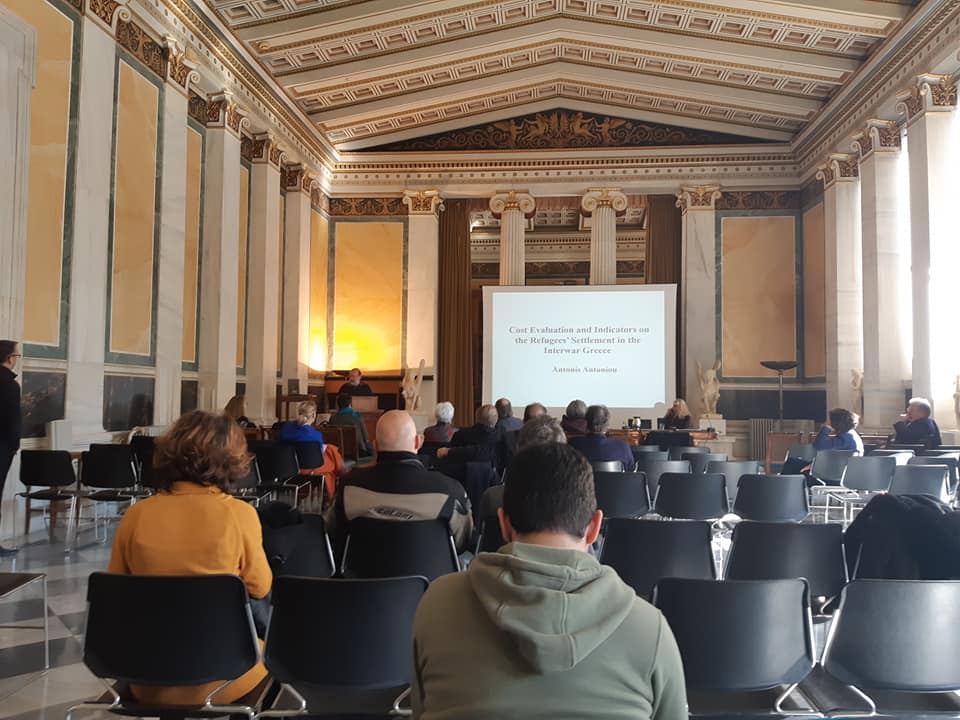
Antonis Antoniou
Cost Evaluation and Indicators on the Refugees’ Settlement in the Interwar Greece
For the dispersal of refugees in the Greek state, the refugee settlement was implemented mainly in Macedonia and Thrace. Large-scale settlement of refugees also took place in Attica, where 42% of the refugees who settled in urban areas lived. The distribution of refugees by gender reveals that male refugees are presented in the census at a lower rate than women. Despite the fact that the local population is coming out of a ten-year war period, the widowhood rate is significantly higher among the refugees and it seems that young men are widowed to a greater extent than the elderly. The widows of the refugees were from 1.2 to 3.4 times more than those of the native Greek population. The refugees had an advantage over a productive population of 15-64 years compared to the locals. In industry, trade, services and fisheries predominate in participation of the total population.
An interesting element for the gender history is the fact that the female refugee population seems to be at a higher literacy rate and more integrated in the production process than the female population of Greece as a whole.
Lefteris Tsoulfidis
The Interwar Refugee Crisis and the Great Depression in Greece: Facts and Reflections
The refugee crisis in Greece in 1922 and the forced exchange of populations in 1923 left an indelible mark on the evolution of Greek society. It was not only the large dimensions of the population movements, in and out of Greece but also the creation of divisive reality and atmosphere that continued many decades after. In effect, social cohesion has been a major issue and remains on the agenda for action even in Modern Greek society. The question of the refugee crisis then and now gives rise to certain social behavioral patterns, which are worth studying not only to understand what happened in the past as a purpose in itself but to provide us with the necessary information for action today. With these in mind, we discuss population statistics and the effectiveness of public policies during the interwar period in Greece. We find that the Greek society and government made valiant efforts to offer solutions, and it seemed that were met with partial success; however, the crisis of the 1930s and WWII were a setback to these efforts. The current refugee crisis shares many similarities with that of the interwar period but also characteristic differences, which demand particular attention.